Automating bunker delivery notes
Shipomate is a document intelligence platform Doclo built for commercial shipping. It processes Bunker Delivery Notes automatically, catching fuel shortages and compliance issues that manual review misses.
$2K+
Avg. shortage detected per BDN
<30s
Full BDN processing time
60+
Fields extracted per document
The bunkering problem
The global bunker fuel market is worth over $150 billion annually. Every time a commercial vessel takes on fuel, the transaction generates a Bunker Delivery Note (BDN), the legal record required under MARPOL Annex VI. A BDN documents the fuel type, quantity delivered, density, sulfur content, flash point, and supplier details. It is retained onboard for three years and serves as the primary proof of regulatory compliance.
Alongside the BDN, a Certificate of Quality (COQ) is provided by the supplier, confirming the chemical composition and specification of the fuel as tested before delivery. In theory, the BDN and COQ should agree. In practice, discrepancies between them are common and frequently go unnoticed.
The scale of the problem is significant. A 2022 study by FuelTrust found that over 39% of global bunker deliveries showed fuel content discrepancies of 2% or more compared to delivery paperwork, with average losses of nearly $15,000 per affected delivery. Industry-wide, fuel fraud and quality issues are estimated to cost over $5 billion annually and have disabled more than 600 vessels in a single year.
These are not just financial losses. Since the IMO 2020 sulfur cap took effect, vessels must burn fuel with no more than 0.50% sulfur globally, dropping to 0.10% in Emission Control Areas (ECAs). A sulfur violation can mean port state detention and six-figure fines. Flash point violations create safety risks. And fuel quality issues, from water contamination to off-spec viscosity, can cause main engine damage averaging $545,000 per incident.
For ship owners, managers, and charterers, the documents are there. The data is on the page. But BDNs arrive as handwritten forms, printed documents, scanned PDFs, and photographs taken dockside. Review is manual: someone eyeballs the numbers, maybe checks one or two fields, signs off, and files it. Fuel shortages go unnoticed. A sulfur figure transcribed incorrectly on the BDN never gets cross-checked against the COQ. A density conversion that does not add up gets accepted because no one re-ran the math.
What we built
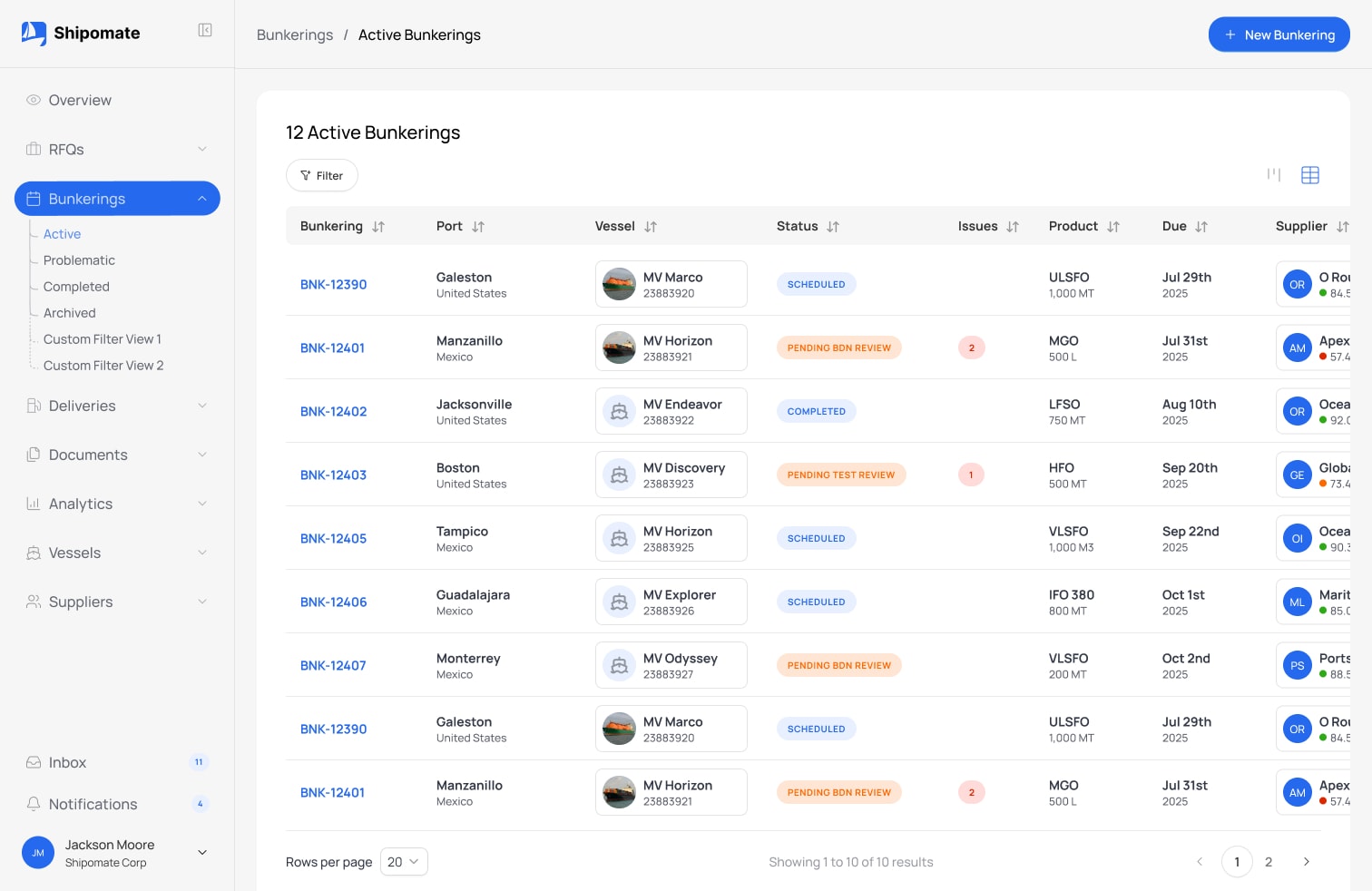
Doclo built Shipomate, a dedicated document intelligence platform for the commercial shipping industry. The system is tailored to each customer's specific vessels, fuel specifications, and operational requirements, and automates BDN processing end to end, from document ingestion through to validated, actionable reporting.
Designed around existing workflows
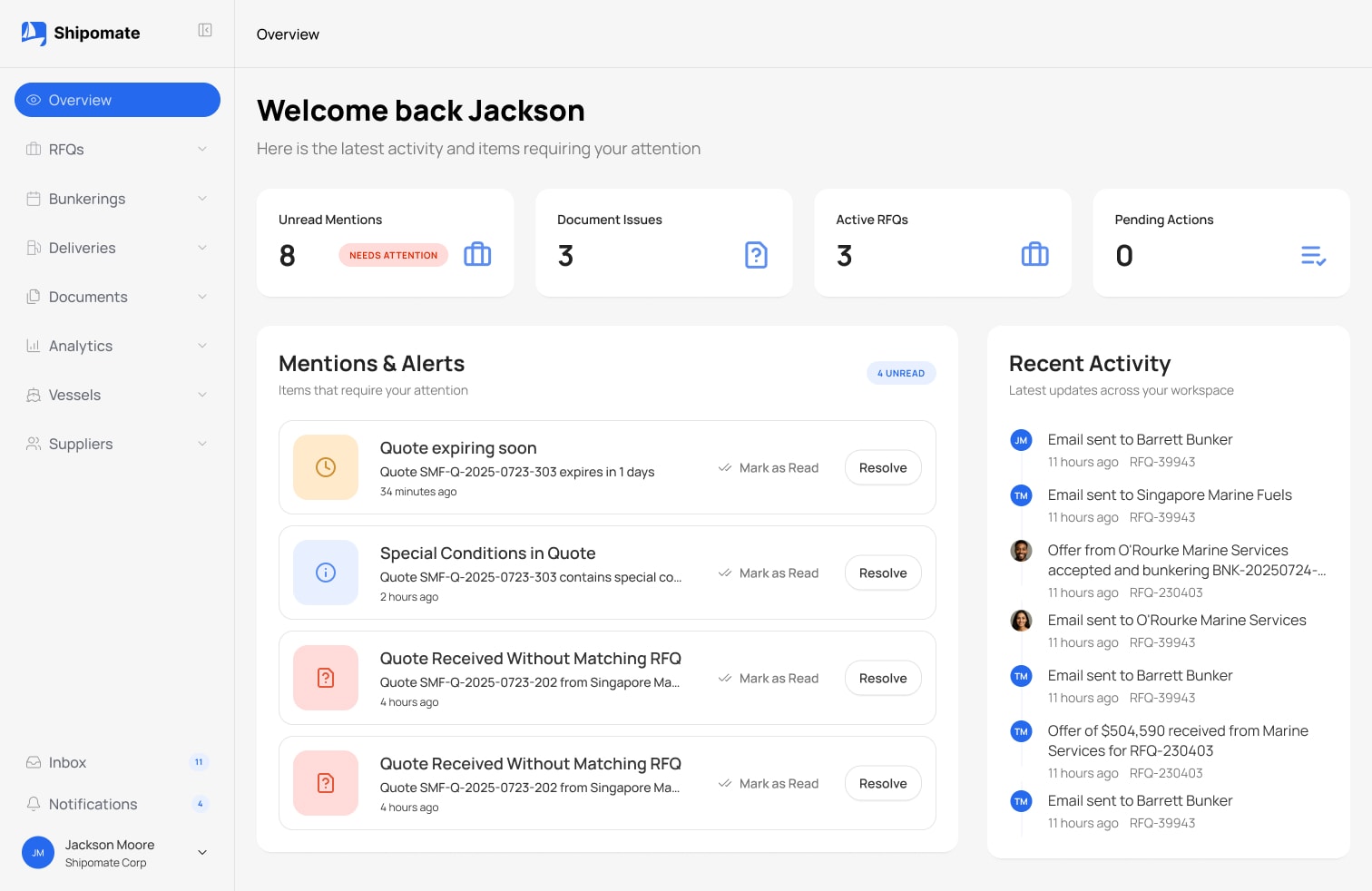
Like all Doclo deployments, Shipomate slots into the way teams already work. BDN emails were already being forwarded from ship to office, so integrating Shipomate meant simply CC'ing a custom Shipomate email address. The system ingests documents from the attachments, runs the entire validation process autonomously, and notifies the team when results are ready for review, when issues need attention, or when a report is available. No new software for port agents or suppliers to learn.
Extraction across 60+ fields in under 30 seconds
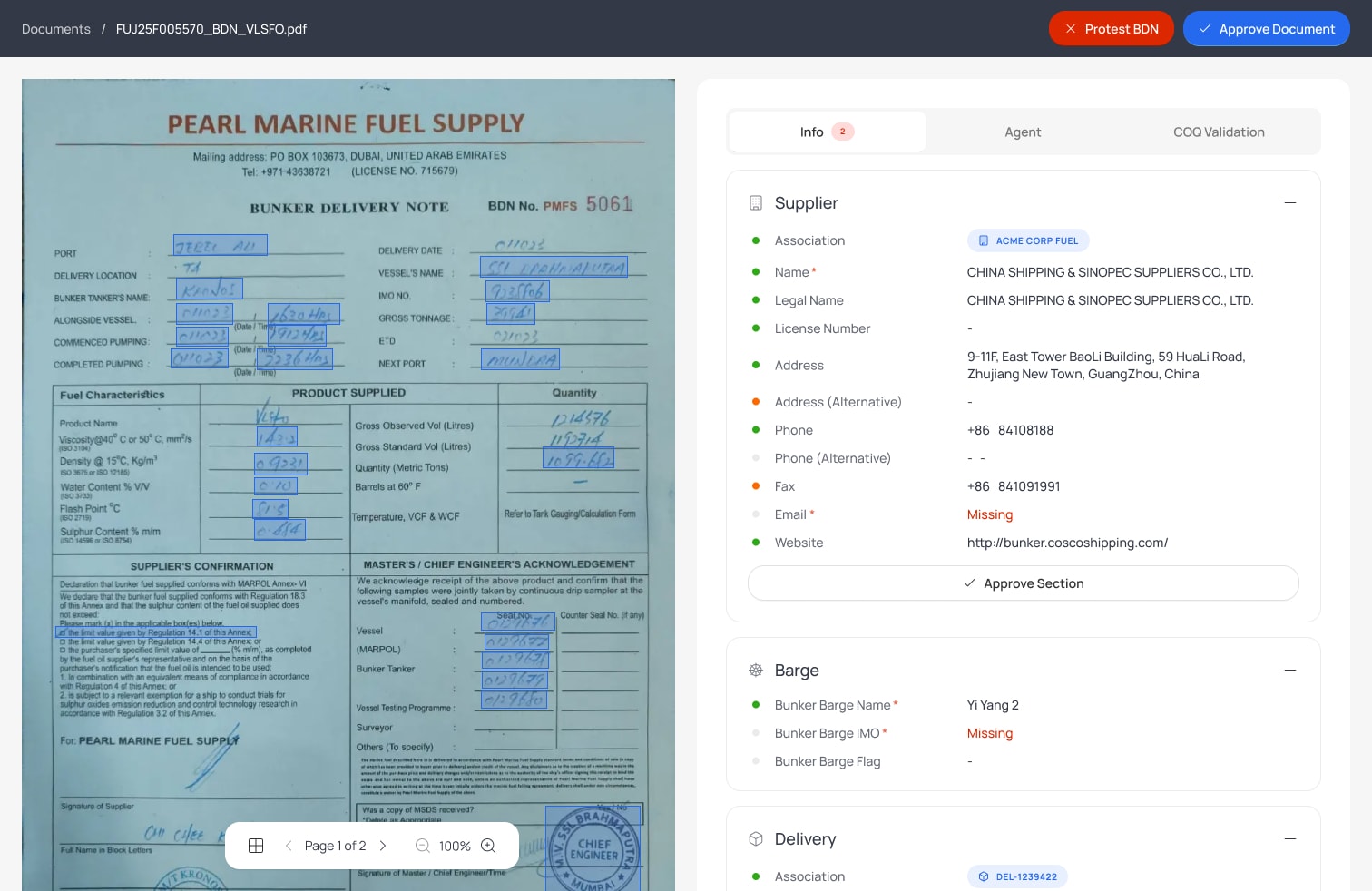
The system reads handwritten BDNs, printed forms, and photographed documents. It extracts fuel type, quantity delivered, density at multiple reference temperatures, sulfur content, flash point, viscosity, supplier details, vessel name, port of delivery, and dozens of additional fields. Each extracted value includes a confidence score, and high-consensus answers are flagged so the user knows exactly where to focus attention.
Automated math and specification validation
Every calculation on the BDN is independently verified. Delivered quantities are reconciled against ordered quantities to identify shortages. Density conversions are checked. Sulfur content and flash point are validated against IMO 2020 regulations and regional ECA requirements. The system catches the kind of errors that slip past manual review: a sulfur percentage overstated by an order of magnitude, a quantity discrepancy hidden in rounding, a flash point reading that technically passes but sits right at the regulatory boundary.
Cross-document reconciliation
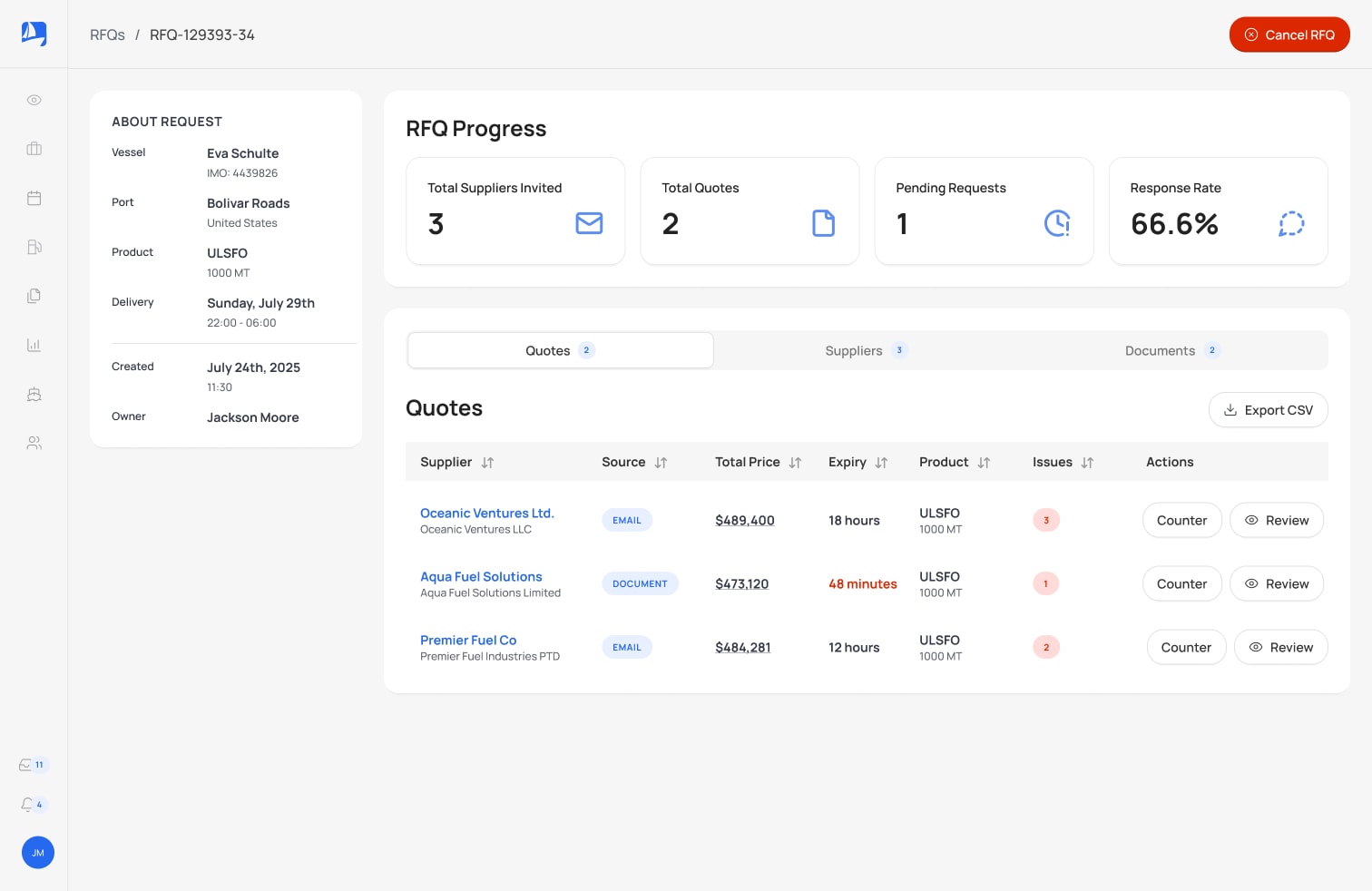
BDN data is compared against Certificates of Quality, purchase orders, and RFQ specifications. When the COQ says one thing and the BDN says another, the system flags it immediately rather than waiting for someone to notice.
Visual problem reporting
The output highlights every problem area with bounding boxes on the original document, so users can see exactly where each extracted field came from and where issues were found. No digging through raw data or toggling between spreadsheets and scanned images.
What the pilot revealed
During an initial pilot with one of Shipomate's first customers, the system was pointed at just 10 historical BDNs. These were documents that had already been reviewed, signed off by the chief engineer, and filed as complete. Within those first 10 documents alone, the results were immediate.
Within those first 10 documents alone, the system detected over $20,000 in fuel shortages that the owner had not caught. That works out to an average of over $2,000 per BDN in quantity discrepancies that had been accepted and paid for without question.
The system also caught compliance and quality issues that had been missed by both the reviewing manager and the fuel analysis company.
Sulfur content overstated by 10x on a BDN
The COQ for the same delivery showed sulfur at an appropriate percentage, but the BDN listed a figure that would have been a serious violation. The chief engineer had accepted the fuel and signed off on the document. It turned out that when the BDN was filled out, a zero had been missed after the decimal point. Had the fuel actually been at that sulfur level, the vessel would have been operating in violation of emissions regulations. Neither the owner's team nor the fuel analysis company flagged the discrepancy.
Quantity overstatements and calculation errors
Several BDNs contained demand overstatements where the recorded delivered quantity exceeded what the math supported after independent density conversions. These overstatements were the primary driver behind the fuel shortages detected. Small math errors that individually look like rounding issues compound across hundreds of bunkering events per year.
Specification boundary issues
Flash point and viscosity readings that technically passed but sat close enough to regulatory limits to warrant attention, especially for vessels operating in ECAs where enforcement is strict and tolerances are narrow.
Technical approach
The platform handles significant format variation across ports, suppliers, and handwriting styles without requiring manual configuration for each new document layout. Validation rules are deterministic: sulfur limits, quantity tolerances, density conversion formulas, and required fields are checked against configurable business rules rather than AI-generated judgments. This gives operations teams confidence that compliance checks are consistent and auditable.
Processing a single BDN takes under 30 seconds from intake to fully validated output. For a fleet running dozens of bunkering events per month, that turns what was previously hours of manual review into a near-real-time quality control process.
Results
$20,000+ in fuel shortages detected across the first 10 BDNs
Documents that had already been reviewed and signed off contained quantity discrepancies averaging over $2,000 per delivery. These were costs the owner had already accepted and paid for.
Compliance violations caught that manual review missed
Including a 10x sulfur content error on a BDN that neither the owner's team nor the fuel analysis company had flagged. The chief engineer had signed off on the delivery.
60+ fields extracted per document in under 30 seconds
Every extracted value includes a confidence score and visual bounding boxes mapped to the original document, so users can verify any field instantly.
Full audit trail for every bunkering event
Every BDN processed generates a complete record of what was extracted, what was calculated, what was validated, and what was flagged.
Ready to see similar results?
Talk to our team about how Doclo can fit into your workflow. No commitment, just a conversation.